Nikos Zorbas: Customer dissatisfaction is an opportunity for improvement
Nikos Zorbas, author of the book Customer Escalations Management: The Golden Recipe, spoke to BusinessNews.gr about his book, which became the No. 1 Best Seller on Amazon in the Service Industry, Public relations categories.
Nikos Zorbas’ book focuses on processes and tactics, the required business structure, and the importance of human relationships and resources, while describing why ensuring a positive customer experience is more important than ever. The author spoke to us about the book that reached the top of the Amazon lists.
What led you to write a management book?
The decision came first from my deep belief that knowledge should be shared. In a world of constant change that requires businesses to constantly adapt, knowledge transfer and adequate communication are not only useful, but necessary for growth and success. By writing this book, I was given a unique opportunity to share the experience that I was fortunate enough to collect through my years of activity in the field of customer experience, conveying proven practices and strategies that can be applied to various business situations and describing the value of continuous improvement of the customer experience, ethical and customer-centric leadership, but also the continuous education of support representatives. In this way, I hoped and hope that the content of the book will add a small stone to the creation of even more positive and efficient means of interaction between businesses and customers, reinforcing the importance of shared success and growth.
How can businesses manage customer dissatisfaction? Can they work to their advantage?
Although there are several effective techniques and procedures that I have tried to capture in my book, I would say that all of them have as their ultimate goal to promote three basic principles, which ensure the most appropriate management of customer dissatisfaction and escalations: the most direct, transparent and effective communication possible, accuracy in the analysis of incidents and ultimately the provision of solutions that will not only constitute superficial corrections, but will offer sustainable improvements. Certainly, the golden recipe for success for each business is the result of a mix of management options that meets the specific requirements of the customers it addresses. At this point, it is worth noting that the occurrence of customer dissatisfaction is something that can be limited to a significant extent, but cannot be excluded. This is a result of many factors, such as possible difficulties in internal processes, unforeseen external events or even due to the diversity of customer needs.
However, in those very places of new challenges, new opportunities are also hidden, as we must remember that it is not the failures that characterize businesses, but the way in which they respond to them. For this reason, one of the most important messages I would like to convey is that the process of resolving customer dissatisfaction and escalations should not be treated as a negative experience but as an opportunity for improvement, both for the business and for the relationship with the customer. Such a culture activates the continuous search for areas of upgrading the service provided, which not only enables businesses to strengthen trust with their customers, who actually receive this effort, but also to lead to innovative solutions, improvement of their products and services or even the development of new communication and management strategies.
How can businesses guide employees who interact directly with customers to understand which issues need to be resolved immediately and which need to be escalated?
To ensure the most appropriate management of the issues that arise, it is necessary to implement a methodology that has as its main pillar the continuous education, training and support of service representatives. It is very important that those who are on the front line of interaction have cultivated their empathy, have knowledge of the products and services, as well as an image of the best support practices. At the same time, it is necessary to have clear instructions and protocols for the correct categorization and handling of support requests, as well as access to technological tools or systems that facilitate the recording, monitoring and making management decisions and timely escalation.
It should therefore be mentioned here that the role of management is of particular importance, not only in ensuring the aforementioned but also in encouraging open communication, within the framework of a safe environment – within which even mistakes are acceptable – thus strengthening the autonomy and self-confidence of the staff. Of course, a clear methodology will also contribute to faster and more effective decision-making, but let’s not forget that new incidents will always arise, which will either be unclear or completely uncharted. For this reason, service representatives need to know that they have the ability to take initiatives, ask for guidance and discuss uncertain situations or challenges, as well as to openly share not only successes, but also needs or failures, with the aim of continuously improving processes.
How can a business strengthen relationships with its customers when there is no frequent physical contact?
First of all, it is important to confirm that indeed, to this day, the positive impact of physical contact often cannot be fully replaced and therefore it continues to be an important way of communication when possible. However, we would say that we now have sufficient knowledge, means and tools that allow us to make customers feel increasingly closer to businesses, through alternative modern approaches, targeted actions and creative strategies. Let me start by mentioning that a company’s values are a fundamental strategy for strengthening customer relationships. Especially when customers see their own values reflected in a company, they tend to feel a deeper, more personal connection with it. For example, modern customers are -rightly- placing increasing emphasis on social responsibility and sustainability. Businesses that emphasize and align with these values can in fact create stronger relationships with these audiences, through a shared value system.
Subsequently, sending personalized communications in any form, with updates, satisfaction surveys, offers, thank-you or greeting messages or even advice on how to use products or services, is another tactic for strengthening relationships, as the business shows that it treats each customer as a personality, offering a more personalized experience, which respects the preferences, needs and uniqueness of each individual. Another interesting and extremely useful strategy is the use of electronic media with the aim of creating a community where customers can exchange opinions, receive advice and share their experiences with products or services. This effort requires the active participation of the business and can be strengthened by parallel actions of interactive presence on social media, organizing online webinars or other online events that offer value to customers and help them feel more connected to the business, as well as creating programs that reward them for their purchases or referring new customers.
In closing, it should be mentioned that it is important for customers to feel that they can easily communicate with each company through the channel they consider optimal. Therefore, one of the challenges that modern businesses now have to face is the provision of services through multiple channels, such as telephone, email, live chat, etc., which requires resources but also a different approach to staff training, so that the form of communication is adapted to each channel.
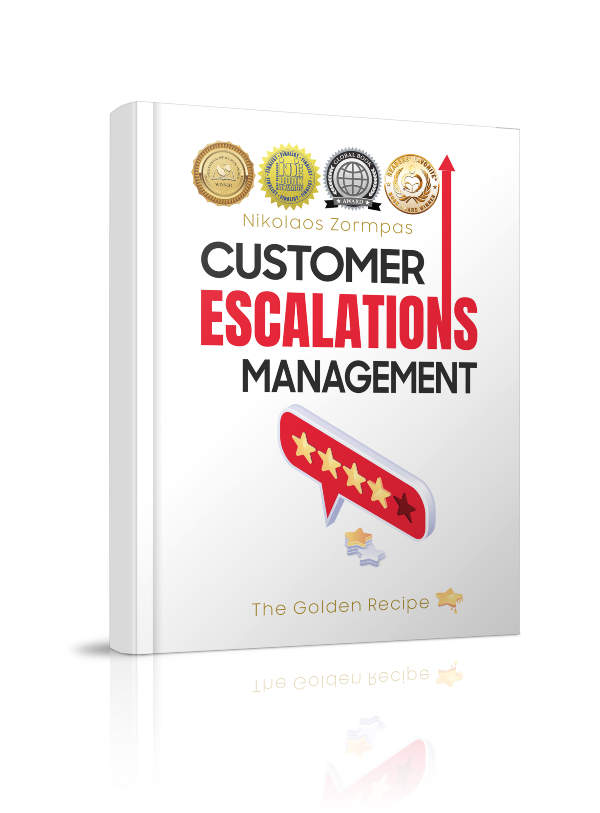
Your book, Customer Escalations Management, was ranked No. 1 Best Seller on Amazon in the Service Industry, Public relations categories and has received several international awards. What is the reason for this?
Let me tell you honestly that the course of my book up to now, apart from being honorable, has also been unexpected. I remember watching the international competitions announcing its distinction among thousands of other excellent business-themed choices and having a hard time realizing it. So, wondering myself, I now have the feeling that this widespread acceptance was the result of four main factors.
The first of these was the timing. I was lucky enough to be able to write a book on ensuring positive customer experiences, with this particular topic being on the business scene like never before. This means that there was an audience that was actively seeking this information. The second factor, I believe, was my effort not to approach the book as a theoretical guide, but to enrich it with practical tactics and examples for immediate implementation. Therefore, readers knew that there were quite a few chances to identify an opportunity for immediate implementation from the very first chapters. An additional point that I believe contributed was the concentration of specialized knowledge in one source, but seen from a anthropocentric perspective and from the, as it turns out, interesting perspective that customer dissatisfaction and escalations are actually opportunities. And finally, one of the most important factors that is connected or, if you like, perhaps a result of the aforementioned, was the positive reviews and recommendations that accompany my book to this day. Let me share with you that the feeling of seeing one’s writing attempt and in this case one’s experience, recognized as useful by readers all over the world, by some of the most well-known and important names in the international customer experience field, as well as by many top executives worldwide, is not easy to describe adequately. However, it was and remains a powerful driving force that honors me beyond imagination and maximizes the credibility and attractiveness of my book on a global level.
Mr. Zorbas is a senior executive with expertise in designing and implementing innovative strategies to ensure positive customer experiences.